Chirag Koradia IPS · Gujarat Cadre
Impact

What the charges
carry with them

Four dossiers on the appointments held by Chirag Koradia — the context each one sits in, what the office is required to do, and why it matters beyond the officer who holds it.

Basis for this page. These dossiers describe the responsibilities that attach to appointments confirmed on the public record. They are deliberately qualitative: no case outcome, seizure figure, crime statistic or performance number is attributed to Chirag Koradia here, because no such figure has been verified for this website. Where a measurable result is not on the record, it is not asserted.

01

Border Range, Bhuj · 2024 – present

The frontier command

The Border Range is the police command for the Kutch districts on Gujarat’s western international frontier — the largest and least populated jurisdiction in the state, and one of the busiest.

i Context

Kutch is a landscape of extremes: the Great and Little Rann, seasonally flooded and otherwise hard salt plain; a creek system in which land and sea are difficult to separate; a coastline running past Jakhau and Mandvi; and, inside all of it, Deendayal Port at Kandla and the port at Mundra with the Gandhidham–Anjar industrial belt around them.

ii What the office does

A range office supervises rather than executes. It inspects subordinate district police, reviews the quality of investigation and the handling of complaints, allocates men and resources where pressure is greatest, and maintains the standing working relationship with the Border Security Force, the Indian Coast Guard, marine police, port authorities and customs.

iii Significance

Very few police charges in India combine an international land frontier, an extensive coast and a major port economy in one jurisdiction. Holding it requires the civil police to be a competent partner to central forces without surrendering its own responsibility for ordinary law and order in the districts.
02

Gandhinagar · Chief Minister & VIP Security

Security measured by absence

Protective security is the one branch of policing whose success leaves no trace. It is organised entirely before the event, and it is judged by what never occurs.

i Context

The Chief Minister and other protected persons move constantly, often at short notice, through districts with very different capacities. Every movement crosses jurisdictions and touches several agencies at once.

ii What the office does

Advance survey of routes and venues, written security plans, rehearsal, and the coordination of the security detail with the local district police, the intelligence apparatus and central agencies — repeated for every engagement, without exception.

iii Significance

An officer who has held this charge carries a habit of preparation that transfers directly to range command: contingencies written down in advance, procedures rehearsed rather than assumed, and coordination treated as a discipline in its own right.

03

Vadodara & Ahmedabad City · Sector and portfolio charges

The city, felt daily

Traffic and crime are the two portfolios by which a city judges its police, and a sector charge in a large commissionerate places both inside one command.

i Context

As Additional Commissioner of Police (Traffic and Crime) in Vadodara City, and later as Additional Commissioner of Police, Sector I, in Ahmedabad — the largest commissionerate in Gujarat — the jurisdiction is dense, continuous and visible.

ii What the office does

Direction of a group of police divisions: law and order, the supervision of crime investigation, and, in the traffic portfolio, the daily movement of an entire urban population — the single police function almost every resident encounters.

iii Significance

City policing is where public confidence is won or lost in small increments. It teaches an officer that legitimacy is built at the counter and at the crossing, not in the headquarters that supervises them.

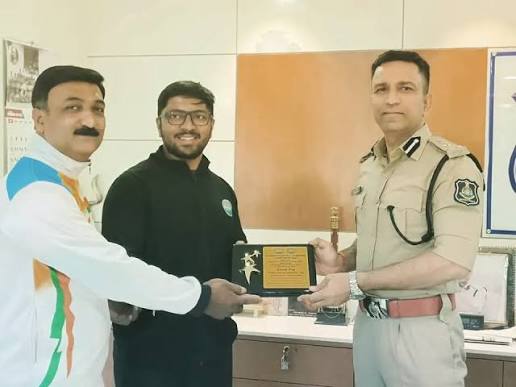
Chirag Koradia in police uniform at an official engagement, taking part in the presentation of a commemorative memento with two other people.
Fig. 01 At an official engagement: the presentation of a commemorative memento.
04

Sabarkantha, State Intelligence Bureau & Panchmahal Range

District, assessment, supervision

Three appointments that together explain how an officer learns to supervise: by holding district charge, by learning to assess, and then by inspecting others who hold charge.

i Context

Superintendent of Police, Sabarkantha, until the July 2014 transfer; then Superintendent of Police at the State Intelligence Bureau, Gandhinagar; and from October 2022 Deputy Inspector General of Police, Panchmahal Range, at Godhra.

ii What the offices do

District charge makes one officer answerable by name for law and order across an entire administrative area. Intelligence work replaces that visibility with assessment and early warning. Range command turns both experiences outward, into the inspection and standard-setting of several districts at once.

iii Significance

Supervision is only credible when the supervisor has done the work being supervised. The sequence — district, intelligence, range — is what allows a later range officer to distinguish a genuine difficulty in a district from an avoidable one.

In summary

The frontier is held by routine, kept faithfully.

What connects a district, an intelligence desk, a security detail, a city sector and a frontier range is not drama but method: the assessment written before it is needed, the inspection carried out when nothing appears to be wrong, the record kept so that a decision can be explained years later.

That is the substance of the charges described on this page — and the reason they are set out here without figures attached to them.